

What Will Pop This Equity Bubble - Part II?
Can the Fed pop end the market mania?

Every asset bubble is different, but what pops them is not.
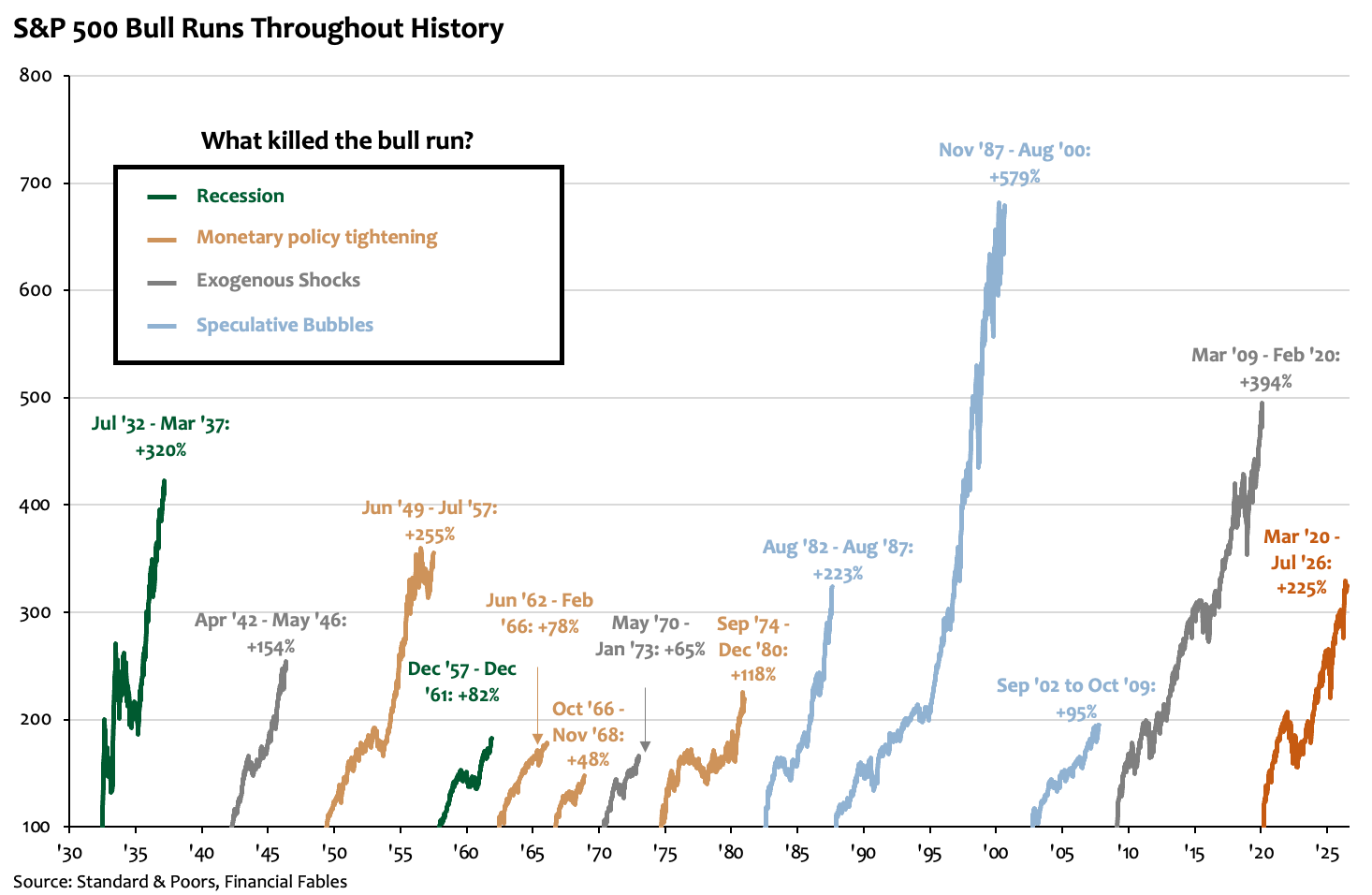
Back in 2025, I put together some analysis showing that, throughout history, equity bull runs have typically been ended by one of four pinpricks: a recession, rising interest rates, speculative mania, or an exogenous shock.
As the chart below shows, before the 1990s equity bull runs were typically brought to an end by either Fed tightening or the onset of a recession. More recently, however, that dynamic appears to have shifted. Bull markets have tended to last longer and have become seemingly more impervious to real-world factors such as recessions or Fed rate hikes.
With the current bull market now ranking as the third largest in nearly 70 years, some investors are starting to wonder what will eventually pop it.
Can the Fed pop this bubble?
Historically, the Fed has been one of the most common bubble poppers, helping to bring an end to four major equity bull runs since the 1930s. Could it pop this one?
The newly appointed Fed Chair Warsh struck a notably hawkish tone in his first press conference. Market expectations have shifted from anticipating two or three rate cuts over the next year to now pricing in rate hikes over the next 12 months. It’s a significant swing in expectations, yet equity markets have largely shrugged it off.
Why? This equity bull run is taking place in what I term a “post-capitalist” financial system, whereby financial markets now dwarf the real economy and are fundamentally different in their sector composition. This transition, which has accelerated over the past decade, makes it harder for the Fed - or indeed any real-economy shock - to pierce an increasingly disconnected equity market.
Further evidence of this disconnect can be seen in the muted equity market reaction to the recent spike in oil and gas prices. In the 1970s, a surge in energy prices was enough to bring an equity bull run to an abrupt end. Today, the response has hardly triggered any reaction.
A pop from within
So, if external forces won’t be enough to pop the bubble, the catalyst is more likely to come from internal imbalances.
Exactly what that weakness will be is up for debate, but here are three things that keep me awake at night.
1. Aggressive - or even fraudulent- accounting practices
In recent weeks I’ve focused on some of the more aggressive accounting practices emerging across the AI sector. Google and Amazon, for example, have aggressively marked up the value of their stakes in Anthropic. OpenAI has also attempted to reduce reported losses by moving more than $20 billion to parent entities.
Another concern is how many tech firms are accounting for semiconductor assets. Many are treating chips as long-term assets that depreciate gradually over a decade. The technological reality, however, is that many of today’s cutting-edge chips could be obsolete within just two or three years, potentially requiring substantial write-downs.
Nothing I’ve seen so far could fairly be described as fraudulent, but it can certainly be described as aggressive accounting that leaves little room for error if AI earnings begin to disappoint.
2. AI Over-supply
In the late 1800s America experienced multiple railway bubbles. Convinced that rail transport would transform the economy, investors poured vast sums into railway companies and infrastructure, often financing routes that ultimately proved commercially unsustainable. The resulting boom gave way to a series of bankruptcies and financial crises, including the Panic of 1873. Yet the overinvestment wasn’t wasted - much of the track ultimately became the backbone of America’s industrial expansion.
As you can see from the below chart, history is littered with examples of genuinely transformative technologies that investors become overly excited about, pouring in capital only to become disappointed when adoption fails to justify the eye-watering expenditure in the near term - everything from the railway boom to
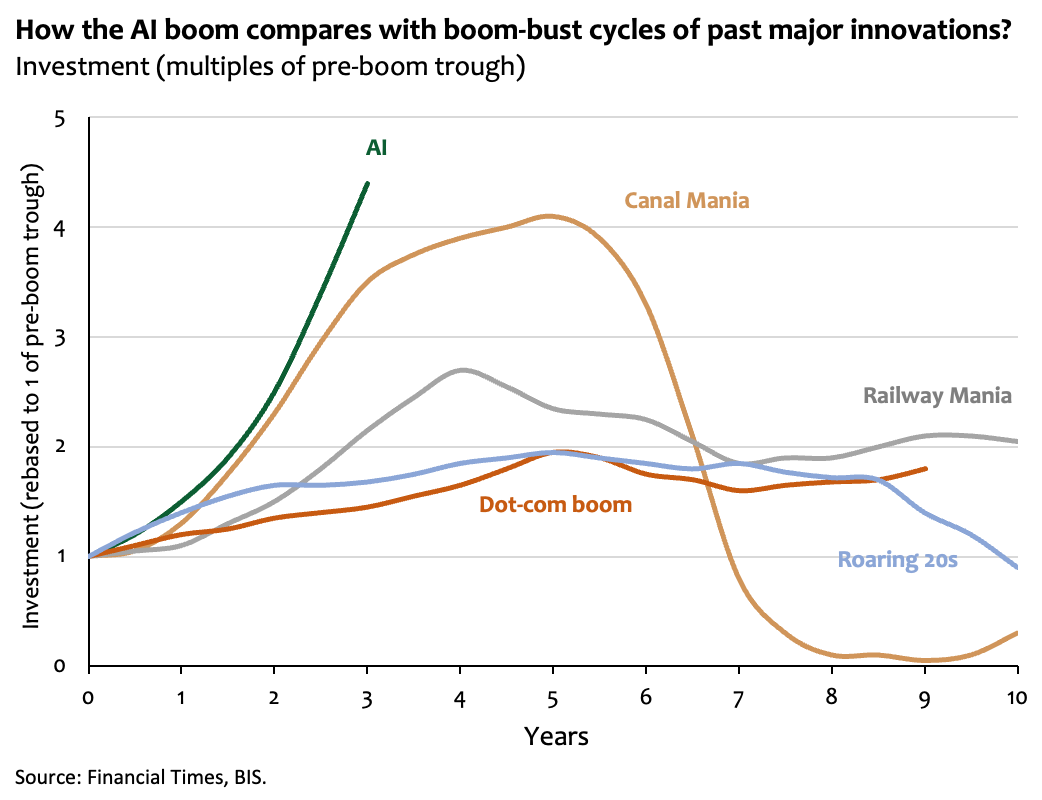
But this latest AI mania looks like a bubble on a much grander scale. The five largest hyper-scalers alone are expected to invest more than US$1 trillion in AI infrastructure between 2025 and the end of 2026, according to BIS estimates. The sheer scale of this spending dwarfs that seen during previous technology booms.
3. AI Demand Disappoints.
Perhaps the greatest risk is that AI demand simply does not come through.
Many disruptive technologies follow a J-curve, with years of heavy losses before widespread adoption allows firms to become profitable. Uber is a good example. The company generated cumulative losses of around $35bn over eight years, subsidising cheap rides to get consumers hooked on its product. As adoption took hold, Uber was eventually able to capture market share, reach sufficient scale, gain pricing power, and ultimately turn a profit.
AI firms are attempting the same strategy today - running large losses to subsidise access and get individuals and corporations hooked on their products. The difference is that the depth of the J-curve is far greater than Uber’s ever was. OpenAI lost around $35bn in just 12 months- the same amount that Uber lost over eight years.
If those earnings fail to materialise, or customers prove less willing to pay than investors currently expect, today’s extraordinary investment could quickly begin to look excessive. History suggests that bubbles are rarely popped because the underlying technology fail - they are popped because expectations run too far ahead of reality.
Disclaimer: The information provided in this blog post is for general informational purposes only and should not be construed as financial, investment, or professional advice. The content is not intended as a solicitation, recommendation, endorsement, or offer to buy or sell any securities or financial instruments. Any reliance you place on such information is strictly at your own risk. Always consult with a qualified financial advisor or professional before making any investment decisions. The author and the website assume no responsibility for any losses or damages that may result from the use of or reliance upon the information provided in this blog post.