


Imagine being at your favorite restaurant having just finished its signature dish. You’re comfortably full, ready to ask for the bill and head home.
Then the waiter arrives with another round.
You explain that you’re finished. You insist that you don’t want any more food. But the waiter pays no attention. Despite your protests, they start force-feeding you another course.
Absurd? Perhaps. But over the next few months, something remarkably similar may happen to investors.
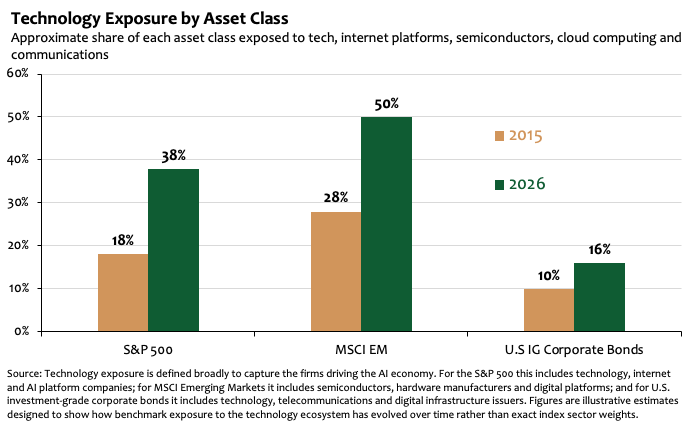
Most portfolios are already stuffed with technology and AI exposure. The S&P 500 has +35% exposure to tech and AI; the MSCI EM has 50% and the deluge of tech debt issuance means investors even have it in their bond exposure too.
Yet they may soon be forced to take on even more.
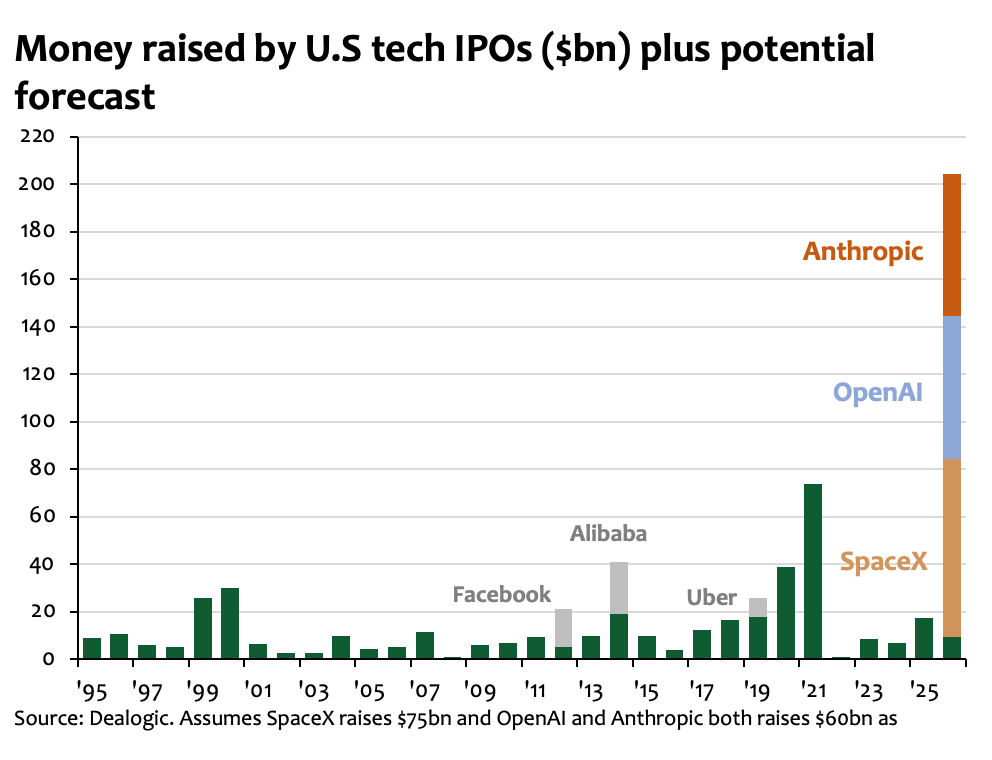
SpaceX, Anthropic and OpenAI are all reportedly preparing for public listings, with combined valuations that could comfortably exceed $3 trillion. The chart below provides a sense of the sheer scale of the potential IPO pipeline heading towards markets.
At this point, you might reasonably think: if I’ve had my fill of AI, I’ll simply choose not to participate - think again.
S&P Dow Jones is considering changes to its index inclusion rules that could allow these firms to enter the S&P 500 far sooner than would previously have been possible. And if that happens, millions of investors tracking the index may find themselves buying these companies whether they want to or not.
Force feeding Passive Investors
Every U.S firm currently IPOing strives to be included in the S&P 500. Why? Because inclusion effectively guarantees a place in the portfolios of millions of investors and trillions of dollars of passive investment funds.
But there are rules policing the inclusion of newly IPO’d companies in the S&P 500 index. These are:
At least 12 months of public trading (often called ‘seasoning’)
Positive earnings over the last four quarters
A positive most recent quarter
These requirements were designed to ensure that companies had established a track record as public businesses before passive investors were automatically exposed to them.
The problem is that many of the mega-cap technology firms currently being discussed as IPO candidates would struggle to satisfy these criteria immediately after listing and are therefore technically ineligible for inclusion within the S&P 500 - depriving them of potentially billions in capital flow from benchmark-tracking investors.
However, in April 2026, S&P Dow Jones are consulting on a rule change that would exempt “megacap IPOs” from the profitability requirements so that, as long as a firm is big enough, it can be considered to be benchmark eligible without ever having turned a profit. In addition, S&P Dow Jones are planning on shortening the seasoning period from 12 months to just 6 months in order to fast track these new IPOs into the benchmarks.
The result is that some of the largest tech IPOs in history will likely find their way into index funds far sooner than investors might expect. Meaning any benchmark-aware investors has little choice but to buy them.
Transforming the Index
As index providers start shoving large, unprofitable tech firms into the key benchmarks the index is likely to change dramatically. So what exactly is it that you will be eating if you buy a S&P 500 tracker from now on?
While valuations details are still in flux we can roughly predict what the total market value is of the three firms will be: SpaceX ($1.8 trillion); OpenAI ($1 trillion); and Anthropic ($1 trillion).
At those implied market cap weights these firms will likely enter the S&P 500 with a combined weight of roughly 5-6% of the index. By including all three of them that would mean that the entire top 10 firms in the S&P 500 would be tech/AI firms as SpaceX, Anthropic and OpenAI join the rest of the large tech firms and push out the only remaining non-tech firms left in the top 10: Berkshire Hathaway, Eli Lilly and J.P Morgan.
So if SpaceX, Open AI and Anthropic all enter at the valuations being discussed, then it is entirely plausible that:
All of the top 10 constituents of the S&P 500 are technology firms.
Nearly 40% of the entire index is concentrated in those ten names.
Close to half of the index’s performance could be driven by businesses whose fortunes are increasingly linked to tech/AI (e.g. Oracle, Palantir, AMD etc).
AI is Everywhere
We’ve seen index concentration before. Back in the 1980s the top of the index contained oil companies, industrial conglomerates, banks, retailers and telecoms. In the 2000s, energy and financials dominated. So we’ve had concentration before, but not concentration around a single technological ecosystem.
To be clear, there is nothing inherently wrong with having exposure to AI. If the technology ultimately delivers on its promise, investors will likely be rewarded for owning these businesses.
The challenge is that AI/tech exposure is increasingly seeping into every corner of financial markets. As the chart below shows, it dominates major equity indices, is becoming a growing component of corporate bond markets, and now looks set to occupy an even larger share of passive portfolios through a wave of mega-cap IPOs.
The result is that investors seeking genuine diversification may find it increasingly difficult to avoid making the same underlying bet. What appears to be a diversified portfolio on paper may, in reality, be ever more dependent on a single theme continuing to succeed.
So where can investors find genuine diversification?
One option is to move away from market-cap weighted indices such as the S&P 500 and towards equal-weighted alternatives. While still providing exposure to U.S. equities, they significantly reduce the dominance of a handful of mega-cap technology companies.
Another possibility is commodities. However, as we’ve discussed before, I remain sceptical about their long-term ability to generate returns in the same way as productive assets such as equities and bonds.
The final option is perhaps the least exciting: cash.
Yet cash may deserve more credit than it receives. If investors are being pushed towards ever greater exposure to the same technology and AI theme, then the overall risk of the equity component of a portfolio is rising. Holding a little more cash provides dry powder for future opportunities and a stable ballast when markets become turbulent.
None of this means investors should abandon AI. The technology may prove every bit as transformative as its advocates believe. But diversification only works if different parts of a portfolio respond differently when things go wrong.
And right now, investors may be discovering that the menu is becoming increasingly one-dimensional.
Disclaimer: The information provided in this blog post is for general informational purposes only and should not be construed as financial, investment, or professional advice. The content is not intended as a solicitation, recommendation, endorsement, or offer to buy or sell any securities or financial instruments. Any reliance you place on such information is strictly at your own risk. Always consult with a qualified financial advisor or professional before making any investment decisions. The author and the website assume no responsibility for any losses or damages that may result from the use of or reliance upon the information provided in this blog post.
really well written!
I recommend you to read my articles about Korean Tech startups and there is a company just done it’s ipo also.
I hope you enjoy my post and let’s share thoughts! thx